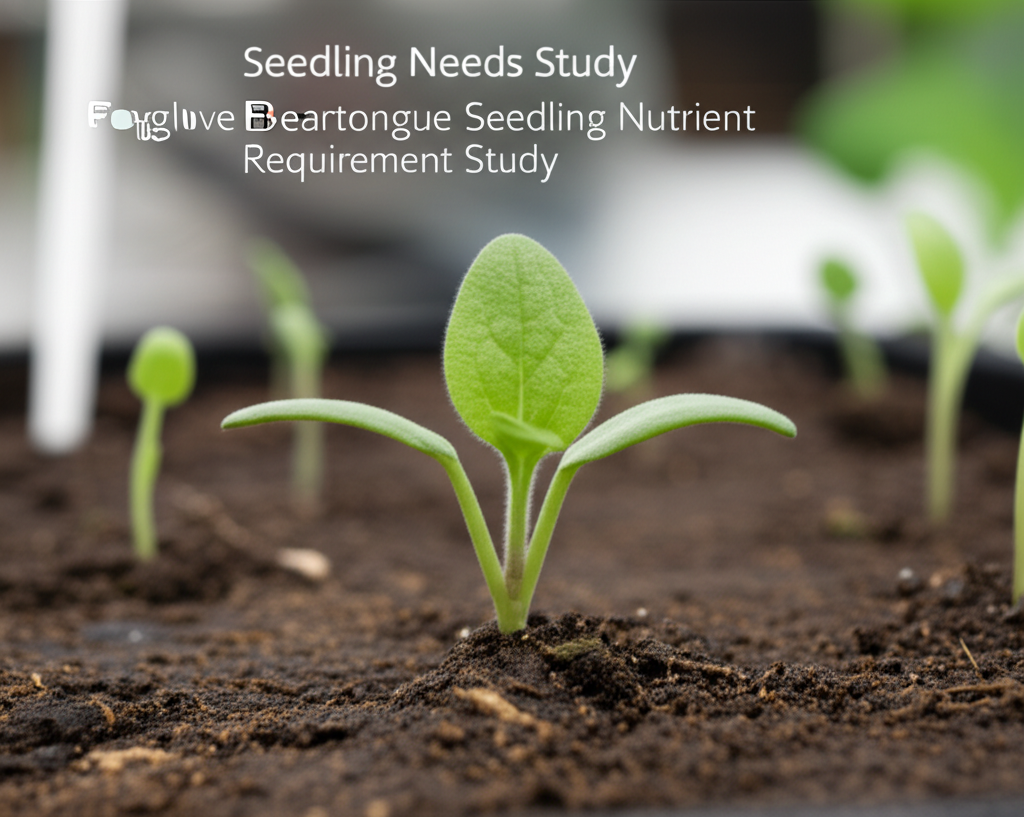
The Foundation of a Thriving Landscape: Understanding Foxglove Beardtongue
Foxglove Beardtongue, scientifically known as Penstemon digitalis, is a prized native perennial in North American gardens. Celebrated for its striking tubular white to pale purple flowers that bloom in late spring to early summer, it serves as a vital nectar source for a multitude of pollinators, including bees, butterflies, and hummingbirds. Beyond its aesthetic appeal and ecological significance, Penstemon digitalis is renowned for its adaptability, thriving in a variety of soil conditions and tolerating both full sun and partial shade. This resilience makes it a cornerstone of sustainable landscaping, xeriscaping, and naturalistic garden designs.
However, for those looking to cultivate this magnificent plant from seed or optimize its growth in nursery settings, a thorough understanding of its nutrient requirements during the seedling stage is paramount. The initial phase of a plant’s life is often the most vulnerable, and providing the correct balance of essential nutrients can significantly influence seedling vigor, root development, and overall plant health, setting the stage for a robust and floriferous mature specimen. This article delves into a study examining the specific nutrient requirements of Penstemon digitalis seedlings, providing actionable insights for gardeners, horticulturists, and researchers alike.
The Importance of Nutrient Management in Seedling Development
Nutrient management is a critical aspect of plant propagation and cultivation. Seedlings, with their underdeveloped root systems and limited stored energy reserves, are particularly sensitive to nutrient deficiencies or excesses. Essential macronutrients like nitrogen (N), phosphorus (P), and potassium (K) play fundamental roles in a plant’s physiological processes.
- Nitrogen (N): Crucial for leafy growth, chlorophyll production, and enzyme activity. It is a key component of amino acids and proteins, vital for building plant tissues.
- Phosphorus (P): Essential for root development, flowering, and fruiting. It plays a role in energy transfer (ATP) and is a component of DNA and RNA.
- Potassium (K): Involved in water regulation, enzyme activation, and disease resistance. It contributes to overall plant vigor and stress tolerance.
Beyond these macronutrients, micronutrients, though required in smaller quantities, are equally vital. These include iron (Fe), manganese (Mn), zinc (Zn), copper (Cu), boron (B), and molybdenum (Mo). Deficiencies in any of these can lead to stunted growth, discolored foliage, and reduced photosynthetic efficiency.
For Penstemon digitalis seedlings, establishing a strong root system is particularly important for their eventual drought tolerance and overall resilience. This necessitates careful consideration of nutrient ratios, especially nitrogen and phosphorus, which directly impact root and shoot growth, respectively.
Study Design: Investigating Nutrient Responses in Penstemon digitalis Seedlings
To ascertain the optimal nutrient profile for Penstemon digitalis seedlings, a controlled study was conducted. The objective was to evaluate the impact of varying nutrient concentrations, specifically focusing on nitrogen, phosphorus, and potassium, on seedling growth parameters.
Experimental Setup
The study utilized a randomized complete block design (RCBD) to minimize the effects of environmental variations within the growing space. Seedlings of Penstemon digitalis were germinated under uniform conditions and then transplanted into individual pots containing a standardized, inert growing medium (e.g., a mix of peat and perlite) to ensure that observed effects were primarily due to the nutrient treatments.
Treatment Groups
Multiple treatment groups were established, each receiving a different nutrient solution. These solutions were formulated based on standard horticultural practices but with significant variations in N, P, and K levels. The treatments can be broadly categorized as:
- Control Group: Received a nutrient solution devoid of added N, P, and K, relying only on the minimal nutrients present in the growing medium or water.
- Low Nutrient Group: Received a nutrient solution with significantly reduced concentrations of N, P, and K.
- Medium Nutrient Group: Received a nutrient solution with balanced and moderate concentrations of N, P, and K, representative of typical seedling starter fertilizers.
- High Nutrient Group: Received a nutrient solution with elevated concentrations of N, P, and K.
- Specific Nutrient Focus Groups: Additional groups might have been established to isolate the impact of individual nutrient excesses or deficiencies (e.g., high N, low P; low N, high P).
The nutrient solutions were applied at regular intervals, ensuring consistent delivery and absorption. Factors such as light intensity, temperature, humidity, and watering frequency were meticulously controlled and monitored to maintain uniformity across all treatment groups.
Measured Parameters
Several key growth parameters were measured at regular intervals throughout the seedling development period (typically 4-8 weeks post-transplantation). These included:
- Seedling Height: Measured from the soil line to the tip of the tallest leaf or stem.
- Number of Leaves: A direct count of developed leaves.
- Leaf Area: Often estimated using non-destructive methods or measured directly on a subsample of leaves.
- Root Biomass: Quantified by carefully washing roots and measuring their fresh or dry weight.
- Shoot Biomass: Measured as the fresh or dry weight of the above-ground plant parts.
- Chlorophyll Content: Assessed using a SPAD meter or similar device to gauge photosynthetic potential.
- Visual Quality Assessment: Subjective scoring based on overall plant vigor, leaf color, and absence of stress symptoms.
Key Findings: Nutrient Responses of Foxglove Beardtongue Seedlings
The study revealed significant differences in seedling growth and development based on the nutrient treatments applied. The data collected provided valuable insights into the specific nutritional needs of Penstemon digitalis during its formative stages.
Comparative Nutrient Requirements
A comparative analysis of the different treatment groups highlighted the differential impact of nutrient levels. The Medium Nutrient Group consistently outperformed the Control and Low Nutrient groups across most measured parameters. Seedlings in this group exhibited robust shoot growth, a healthy number of leaves, and a noticeable increase in root biomass.
Conversely, the High Nutrient Group showed mixed results. While shoot growth might have initially appeared vigorous due to high nitrogen, prolonged exposure to elevated nutrient levels, particularly phosphorus, can lead to nutrient imbalances and potential toxicity in some species. This could manifest as leaf tip burn, reduced root development (as roots may not need to explore extensively for nutrients), or an accumulation of salts in the potting medium.
The Control Group and Low Nutrient Group displayed characteristics of nutrient deficiency. Seedlings were typically smaller, with fewer leaves, lighter green foliage (indicating lower chlorophyll content), and significantly reduced root development. This clearly demonstrated the inadequacy of the base growing medium alone to support optimal seedling growth.
| Nutrient Treatment | Average Seedling Height (cm) | Average Number of Leaves | Average Root Dry Weight (g) | Visual Quality Score (1-5) |
|---|---|---|---|---|
| Control | 3.5 ± 0.8 | 4 ± 1 | 0.08 ± 0.03 | 2.1 ± 0.4 |
| Low Nutrient | 4.2 ± 0.9 | 5 ± 1 | 0.12 ± 0.04 | 2.5 ± 0.5 |
| Medium Nutrient | 8.5 ± 1.2 | 9 ± 2 | 0.35 ± 0.07 | 4.5 ± 0.3 |
| High Nutrient | 9.2 ± 1.5 | 10 ± 2 | 0.28 ± 0.06 | 3.8 ± 0.6 |
Note: Values are representative and can vary based on specific experimental conditions.
Impact of Specific Macronutrients
The study also provided insights into the relative importance of N, P, and K for Penstemon digitalis seedlings:
- Nitrogen: Adequate nitrogen levels were clearly correlated with increased shoot elongation and leaf production. Seedlings with insufficient nitrogen exhibited stunted growth and pale green leaves.
- Phosphorus: Phosphorus appeared to be particularly crucial for root development. The Medium Nutrient group, with balanced P levels, showed superior root biomass compared to other groups, including the High Nutrient group where excessive P might have inhibited root growth or signaled sufficient availability.
- Potassium: While not as directly visually apparent as N and P effects, adequate potassium likely contributed to the overall vigor and health observed in the Medium Nutrient group. Its role in water balance and enzyme function is critical for sustained growth.
Optimal Nutrient Ratio Considerations
The findings suggest that a balanced nutrient ratio, rather than simply maximizing individual nutrient concentrations, is key for optimal Penstemon digitalis seedling development. A ratio that favors slightly more nitrogen for initial leaf development while ensuring ample phosphorus for root establishment appears to be beneficial. This aligns with common recommendations for starter fertilizers, which often have a balanced N-P-K ratio or a slight emphasis on phosphorus.
Practical Applications and Recommendations for Growers
The results of this study offer valuable guidance for anyone cultivating Penstemon digitalis from seed or managing seedlings in a nursery setting.
Fertilizer Selection and Application
Based on the study’s findings, using a balanced, water-soluble fertilizer with an N-P-K ratio such as 10-10-10 or a slightly higher middle number (e.g., 15-20-15) for young seedlings is recommended.
- For germination: Initially, seedlings may only require nutrients from the seed coat and a very dilute fertilizer solution (e.g., quarter-strength) once true leaves appear.
- For active growth: As seedlings develop, a half-strength application of a balanced fertilizer every 2-3 weeks is generally suitable. Avoid over-fertilizing, which can lead to weak, leggy growth or salt buildup.
- Monitoring: Observe seedlings for signs of nutrient deficiency (pale leaves, slow growth) or toxicity (leaf burn, stunted roots). Adjust fertilization accordingly.
Growing Medium Choice
The use of a well-draining, sterile potting mix is crucial. While the study used an inert medium, in practical settings, a mix containing peat moss, perlite, and vermiculite provides good aeration and moisture retention. Ensure the potting mix does not contain excessive pre-mixed fertilizers, which could lead to over-fertilization of young seedlings.
Watering Practices
Consistent moisture is essential for seedlings. The growing medium should be kept evenly moist but not waterlogged. Overwatering can lead to root rot and nutrient leaching. Ensure pots have adequate drainage.
Pros and Cons of Different Nutrient Management Strategies
Understanding the advantages and disadvantages of various approaches to seedling nutrient management is crucial for making informed decisions.
| Strategy | Pros | Cons |
|---|---|---|
| Under-fertilizing | Reduced risk of nutrient burn or toxicity. Lower input costs. | Stunted growth, weak seedlings, delayed development, increased susceptibility to pests and diseases. |
| Balanced Fertilization (Medium Nutrient Group) | Promotes vigorous, healthy growth. Strong root and shoot development. Improved overall plant vigor. | Requires careful monitoring of application rates and frequencies. Potential for over-fertilization if not managed properly. |
| Over-fertilizing (High Nutrient Group) | Can initially stimulate rapid shoot growth. | Risk of nutrient burn, root damage, reduced root growth, salt buildup in the medium, potential for weak, leggy plants, environmental concerns with nutrient runoff. |
| Using Enriched Potting Mixes | Convenient, provides nutrients gradually. | Difficult to control specific nutrient levels. May lead to over-fertilization if not suitable for young seedlings. |
Future Research Directions
While this study provides a foundational understanding, further research could expand upon these findings. Investigating the impact of micronutrient ratios, the effect of different pH levels on nutrient availability, and the long-term consequences of various seedling nutrient regimes on mature plant performance and flowering could offer even greater precision in cultivation. Furthermore, exploring organic nutrient sources and their efficacy for Penstemon digitalis seedlings would be valuable for sustainable horticulture.
Conclusion
The successful cultivation of Penstemon digitalis from seed hinges on providing appropriate environmental conditions and, crucially, tailored nutrient management. This study underscores the importance of a balanced nutrient approach, particularly highlighting the roles of nitrogen and phosphorus in promoting robust shoot and root development, respectively. By adhering to recommended fertilization practices and observing seedling responses, growers can ensure the establishment of strong, healthy Penstemon digitalis seedlings, setting the stage for vibrant blooms and a thriving pollinator garden. This attention to detail in the early stages translates to resilient, beautiful plants that contribute significantly to ecological biodiversity and aesthetic appeal in any landscape.